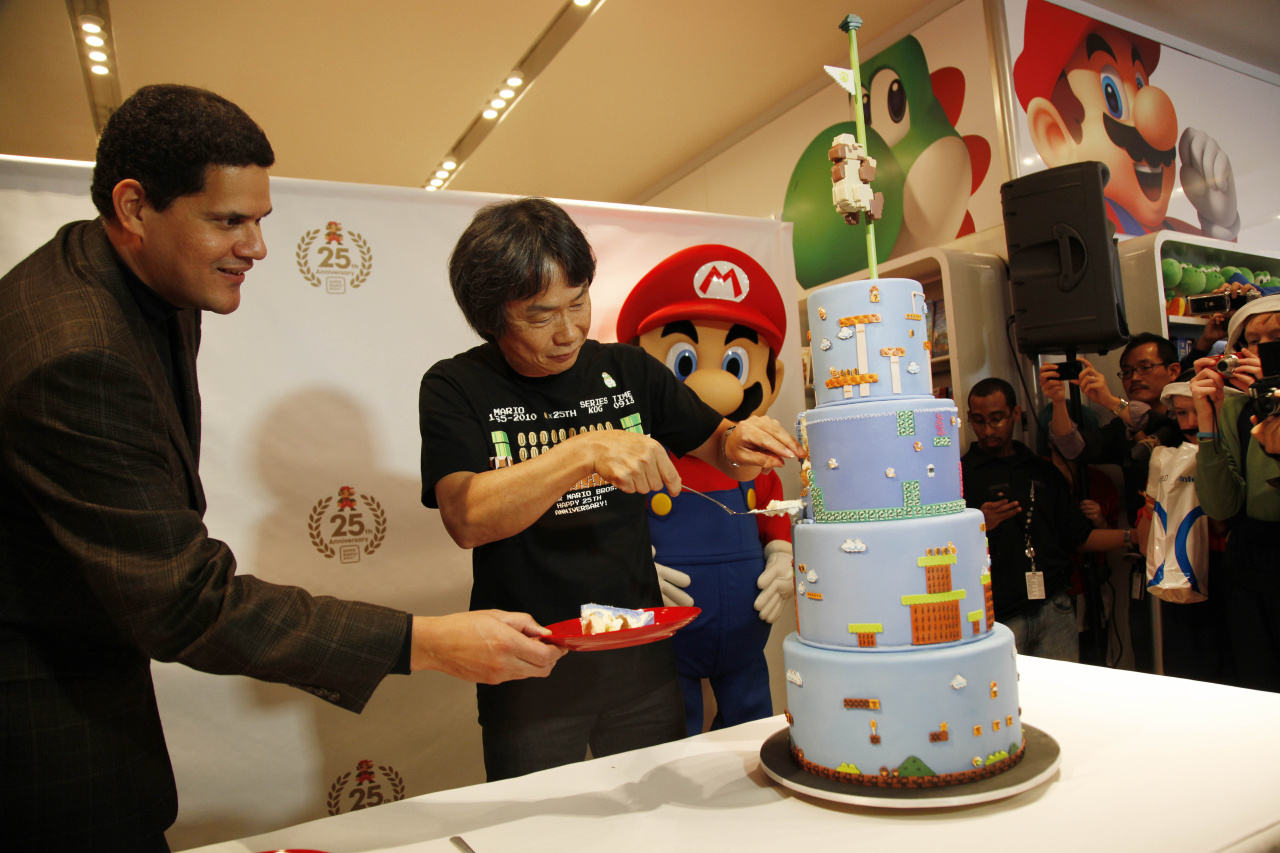
So it's no real secret that Nintendo is celebrating an anniversary this year; the most successful video game character in history turned 30 years old this year, but Nintendo is being a bit more modest in saying that his first true game as their mascot was Super Mario Brothers, which released 25 years ago. And how does Nintendo celebrate 25 years of turtle stomping and mushroom consumption? With a giant cake of course. Oh, and the release of a new game.
Back in the days of the Super Nintendo, the company released a game called Super Mario All-Stars. It was a compilation of Mario's past four main series games: Super Mario Bros., Super Mario Bros. 2, Super Mario Bros. 3, and Super Mario Bros.: The Lost Levels (which is actually Japan's SMB2). Each game received a graphical and audible overhaul to take advantage of the Super Nintendo's 16-bit graphics. The game was a virtual success, becoming the 15th best-selling game for the system.
So someone at Nintendo got this brilliant idea and said, "Remember how we celebrated Mario's 5th anniversary? Well let's get lazy and do the same thing for his 25th anniversary!" And so Super Mario All-Stars was born...again, but this time for the Wii and this time with a book of history and character art as well as a CD soundtrack of various Mario tunes from throughout his history. Of course, some fans were ecstatic, myself included; other were not, convinced that Nintendo just wanted another quick buck and was using the commemorative event to get it. Below are some of the most common complaints I've seen about this release.
"The game itself includes nothing original"
This is true; the Wii remake of Super Mario All-Stars isn't as much of a remake as it is a port. Nintendo has changed nothing; they didn't include any additional games or content and the game is still shown in its original 16-bit format. Now I ask you: is that really such a bad thing? The biggest reason Nintendo released this game is so players could have a collectors item more than a unique gaming adventure. While there may not be anything new, there's plenty of memories to relive in this game. And besides, not everybody still owns the Super Nintendo they grew up with.
"A Super Nintendo game is not worth $30 today"
I will agree with this; I don't think I would ever be caught paying $30 for a Super Nintendo game unless it was one that I desperately wanted. However, Nintendo was well aware of how much a 17-year old game depreciates in this time and decided to include a little incentive to compensate. SNES titles go for about $8 on the Virtual Console. Couple that with the CD and art book included with each copy of the game, I would value it at about $40 altogether; you're actually getting a bit of a deal here.
"They could have at least upgraded the graphics."
Yeah, they could have, but they didn't. They probably wanted to retain the classic feel; we are, after all, celebrating the good old days.
"They could have included Super Mario World, or some other games."
Again, yeah, they could have, but they didn't. At least there are legitimate reasons behind that one: Super Mario World and Super Mario 64 are already on the Virtual Console, Super Mario Sunshine can be played on a Wii, as can Super Mario Galaxy 1 and 2 and New Super Mario Bros. Wii.
"They could have released it to the Virtual Console to save me some money."
Again, yeah, but again, they didn't want to. At some point in time, Nintendo decided it would be better to put the game on a disc and include an otherwise unobtainable CD and book; maybe there's a good reason, maybe there isn't. If you don't like it, don't buy it. And in case you hadn't noticed, Nintendo has pretty much forgotten they even have the Virtual Console since WiiWare launched a couple years ago.
I think given every complaint I've seen, and I have seen quite a few, the biggest recurring issue is people are impulse buying this game; they see 'Mario" in the title and assume it's his next big hit game. The problem is when they impulse buy it, they never take the time to look into it; they don't realize what is included and that it's only a port and nothing more. They don't realize that this wasn't supposed to be a big seller, nor was it intended to be innovative; it's a limited edition collector's item more than anything else. Just enjoy what you get and move on with your life.
On that note, it is a Limited Edition Collector's item, which means Nintendo is only shipping so many units, and once their gone, eBay is your best bet (and while the prices may be reasonable right now, I can't say they will be once the game sells out). If you think it's something you need, you may want to act as soon as possible to ensure you get your piece of history.
12.13.2010
11.01.2010
Review - Fallout: New Vegas
I've been here for a number of days playing the hell out of this game, and I guess the first thing I really need to say is that this game feels like nothing more than a large expansion for Fallout 3. Now don't get us wastelanders wrong; New Vegas delivers everything it promised: new characters, weapons, locations, environments, harder overall difficulty, and some of the greatest humor that can only be found in video games. It's a solid addition to the Fallout canon, but I just don't think the game can't really live up to "astounding."
Please note that OPINIONS and SPOILERS will be riddled throughout this post.
So with that spoiler warning out of the way, let's start with the plot, something I knew nothing of until I placed the game in the disc drive of my Xbox 360. You start off with the classic "War never changes..." bit, delivered by none other than Ron Pearlman. You then find yourself behind the mind of your character, tied up and gagged while five men surround you, one of which is digging a hole. The so-called "leader," if he can so be called (we'll call him fancy-pants, because we can), fiddles with a platinum poker chip that he stole from you moments prior. Fancy-Pants then proceeds to pull out a gun and promptly shoots you in the face. You awaken an indeterminable amount of time later in a doctor's office; it is at this point, you create your character, set your attributes, and set off to find the Platinum Chip that Fancy-Pants stole from you.
The main plot remains solid throughout the story; it starts of as a simple hunting mission. You then find yourself curious about what you've been ruthlessly hunting. After finding (or outright ignoring) what you're looking for, you decide its in your best interests (for whatever reason you want) to change the fate of the Mojave Wasteland. Now wait, this seems familiar; Fallout 3, anyone? While repetition isn't necessarily a bad thing (just look at the amount of popularity the Pokemon games have generated over the years), but when your game is essentially a sixty dollar add-on for an already monumental game, it just feels a little unoriginal. While its true the story will draw you in and poke at your curiosity, it just isn't compelling enough to set it apart from its predecessor, it doesn't pull at your heartstrings as much as Fallout 3's. It can, however, branch off into many different endings depending on your alignment and reputation with each of the game's factions; everything from unifying the wasteland to conquering it can be achieved based on how you play out the main plot line. And just like any RPG these days, the game is riddled with side quests to occupy the time between the campaign. However, it seems at times that even these side quest can drag on and on, usually for a sub-par reward, and usually the main storyline tries to force these quest upon you, preventing you from progressing your desired route unless you complete them. There are well over one hundred quests and side quests to complete (about five times the number in Fallout 3), and while a select few grab your attention as interesting, most of them involve the usual, tedious and repetitive routine: go here, kill/find/destroy/retrieve the indicated item/person, and it usually involves angering a rival faction in favor of another.
The factions system is a welcome addition to the game. If you do a quest for one faction, it could potentially end in a number of ways: you can go through with the original intention, or betray the faction at the last second and help the intended targets. In the end, you'll gain influence with a faction and they'll like you more for it; they'll accept, or even idolize your actions. If you cause trouble for a faction, you may quickly find yourself hated, even vilified, by the faction to the point that they'll shoot on sight, no warning and no questions asked; it could even come to a point where you'll find assassin squads stalking you.
Game-play elements aside, its time to get technical. The visuals are astounding, living up to its legacy to the fullest. However, you should keep in mind that this game runs on the same engine as Fallout 3, so you shouldn't expect to see much of anything new in terms of graphics; it was all done before. You'll even notice some recycled buildings, character models, and other small details; its nothing that brings the quality of the game down as there's certainly more new than there is old.
The interface is largely the same; the HUD is a carbon copy of Fallout 3's with a few tiny additions (like an indicator that reminds you if a limb is damaged or if your radiation is at high levels). The minute changes are more than welcome, but nothing to write home about. The Pip-Boy still functions as the game's inventory/stats screen with no real additions or subtractions.
Fallout 3 players will certainly recognize the ambient music since it was copy and pasted into appropriate areas. This recycling of music doesn't truly distract from the game, but the radio stations become very obnoxious very fast; the local radio station functions similar to Galaxy New Radio of the Capital Wasteland, playing songs from the 50's and 60's, but much like GNR, you'll quickly grow tired of hearing the same songs every ten minutes and on the New Vegas Strip and its hotels. On other station simply plays a talk show between super mutants, and after a very few number of comical exchanges, the station become annoying quickly. As far sound effects go, there isn't really anything a seasoned player hasn't already heard, and the voice acting satisfies in nearly all occasions.
But now we can get down to the meat of the problem. Take a look at any message board regarding the game and you'll find the place littered with complaints about the game's many annoying and sometimes breaking glitches and bugs. True, no game ships flawlessly; there is always going to be some number of bugs in the game, some that can be easily patched. New Vegas shipped with near catastrophic levels of bugs and glitches, rendering the game a pain to complete no matter how much fun you have with it. While most of the bugs aren't game-breaking, they certainly hinder the experience. The game engine shows its age with lengthy loading screens that only get longer with progression. On some occasions, a quest will become impossible to complete because an important character was killed by deathclaws while you were away. Some quests won't update as you complete the goals, leaving you completely in the dark as to what to do next. And much like any game of such size and depth, the game tends to crash and freeze often, and it does so with uncanny frequency the closer to the end you get.
My personal experience with these problems came when my character refused to fire his weapon on my command, rather only firing when I exited some kind of menu; attempting to use V.A.T.S. would only cause my character to aim the weapon, they wouldn't actually fire. While the bug eventually fixed itself, it did inconvenience me by activating in the middle of a heated firefight; I did manage to survive my entering and exiting V.A.T.S. repeatedly (entering V.A.T.S. aimed the attack, and the weapon would fire only once when I exited).
In the midst of all the negative aspects, there is a single factor that this game nailed right on the point: nostalgia, and I don't mean homage to Fallout 3. New Vegas was never meant to be a sequel to Fallout 3, but more of a continuation of the events of Fallout and Fallout 2, and it makes this known with its nostalgia of the two original games, bringing back classic weapons, and making vague allusions to the original classics (such as the Vault 13 jumpsuit that GameStop pre-orders received). Recreating classic weapons and characters that pay homage to two of the greatest RPGs of all time (on specific weapon is named "That Gun," as the developers continued to refer to it as "that one gun from Fallout 2), and bringing back features lost in Fallout 3. As I've mentioned in my previous posts, nostalgia is one of my favorite things about video games these days, and its on factor that New Vegas doesn't falter on.
The Verdict
Make no mistake, readers, New Vegas is most certainly not a bad game, but it is by no means Fallout 3; no matter how similar the games feel to one another, New Vegas simply can't stand up to its predecessor and feels like little more than a sixty dollar add-on. Cloned gameplay, an overall disappointing plot, and a plethora of glitches and bugs bring the experience down, but not to an unplayable point; while tedious and annoying, the bugs can be worked around and patched. All of the positives still outweigh the negatives by a long shot, and seasoned Fallout fans will have an absolute blast exploring New Vegas, but the underwhelming experience will leave you wanting more for your money.
Please note that OPINIONS and SPOILERS will be riddled throughout this post.
So with that spoiler warning out of the way, let's start with the plot, something I knew nothing of until I placed the game in the disc drive of my Xbox 360. You start off with the classic "War never changes..." bit, delivered by none other than Ron Pearlman. You then find yourself behind the mind of your character, tied up and gagged while five men surround you, one of which is digging a hole. The so-called "leader," if he can so be called (we'll call him fancy-pants, because we can), fiddles with a platinum poker chip that he stole from you moments prior. Fancy-Pants then proceeds to pull out a gun and promptly shoots you in the face. You awaken an indeterminable amount of time later in a doctor's office; it is at this point, you create your character, set your attributes, and set off to find the Platinum Chip that Fancy-Pants stole from you.
The main plot remains solid throughout the story; it starts of as a simple hunting mission. You then find yourself curious about what you've been ruthlessly hunting. After finding (or outright ignoring) what you're looking for, you decide its in your best interests (for whatever reason you want) to change the fate of the Mojave Wasteland. Now wait, this seems familiar; Fallout 3, anyone? While repetition isn't necessarily a bad thing (just look at the amount of popularity the Pokemon games have generated over the years), but when your game is essentially a sixty dollar add-on for an already monumental game, it just feels a little unoriginal. While its true the story will draw you in and poke at your curiosity, it just isn't compelling enough to set it apart from its predecessor, it doesn't pull at your heartstrings as much as Fallout 3's. It can, however, branch off into many different endings depending on your alignment and reputation with each of the game's factions; everything from unifying the wasteland to conquering it can be achieved based on how you play out the main plot line. And just like any RPG these days, the game is riddled with side quests to occupy the time between the campaign. However, it seems at times that even these side quest can drag on and on, usually for a sub-par reward, and usually the main storyline tries to force these quest upon you, preventing you from progressing your desired route unless you complete them. There are well over one hundred quests and side quests to complete (about five times the number in Fallout 3), and while a select few grab your attention as interesting, most of them involve the usual, tedious and repetitive routine: go here, kill/find/destroy/retrieve the indicated item/person, and it usually involves angering a rival faction in favor of another.
The factions system is a welcome addition to the game. If you do a quest for one faction, it could potentially end in a number of ways: you can go through with the original intention, or betray the faction at the last second and help the intended targets. In the end, you'll gain influence with a faction and they'll like you more for it; they'll accept, or even idolize your actions. If you cause trouble for a faction, you may quickly find yourself hated, even vilified, by the faction to the point that they'll shoot on sight, no warning and no questions asked; it could even come to a point where you'll find assassin squads stalking you.
Game-play elements aside, its time to get technical. The visuals are astounding, living up to its legacy to the fullest. However, you should keep in mind that this game runs on the same engine as Fallout 3, so you shouldn't expect to see much of anything new in terms of graphics; it was all done before. You'll even notice some recycled buildings, character models, and other small details; its nothing that brings the quality of the game down as there's certainly more new than there is old.
The interface is largely the same; the HUD is a carbon copy of Fallout 3's with a few tiny additions (like an indicator that reminds you if a limb is damaged or if your radiation is at high levels). The minute changes are more than welcome, but nothing to write home about. The Pip-Boy still functions as the game's inventory/stats screen with no real additions or subtractions.
Fallout 3 players will certainly recognize the ambient music since it was copy and pasted into appropriate areas. This recycling of music doesn't truly distract from the game, but the radio stations become very obnoxious very fast; the local radio station functions similar to Galaxy New Radio of the Capital Wasteland, playing songs from the 50's and 60's, but much like GNR, you'll quickly grow tired of hearing the same songs every ten minutes and on the New Vegas Strip and its hotels. On other station simply plays a talk show between super mutants, and after a very few number of comical exchanges, the station become annoying quickly. As far sound effects go, there isn't really anything a seasoned player hasn't already heard, and the voice acting satisfies in nearly all occasions.
But now we can get down to the meat of the problem. Take a look at any message board regarding the game and you'll find the place littered with complaints about the game's many annoying and sometimes breaking glitches and bugs. True, no game ships flawlessly; there is always going to be some number of bugs in the game, some that can be easily patched. New Vegas shipped with near catastrophic levels of bugs and glitches, rendering the game a pain to complete no matter how much fun you have with it. While most of the bugs aren't game-breaking, they certainly hinder the experience. The game engine shows its age with lengthy loading screens that only get longer with progression. On some occasions, a quest will become impossible to complete because an important character was killed by deathclaws while you were away. Some quests won't update as you complete the goals, leaving you completely in the dark as to what to do next. And much like any game of such size and depth, the game tends to crash and freeze often, and it does so with uncanny frequency the closer to the end you get.
My personal experience with these problems came when my character refused to fire his weapon on my command, rather only firing when I exited some kind of menu; attempting to use V.A.T.S. would only cause my character to aim the weapon, they wouldn't actually fire. While the bug eventually fixed itself, it did inconvenience me by activating in the middle of a heated firefight; I did manage to survive my entering and exiting V.A.T.S. repeatedly (entering V.A.T.S. aimed the attack, and the weapon would fire only once when I exited).
In the midst of all the negative aspects, there is a single factor that this game nailed right on the point: nostalgia, and I don't mean homage to Fallout 3. New Vegas was never meant to be a sequel to Fallout 3, but more of a continuation of the events of Fallout and Fallout 2, and it makes this known with its nostalgia of the two original games, bringing back classic weapons, and making vague allusions to the original classics (such as the Vault 13 jumpsuit that GameStop pre-orders received). Recreating classic weapons and characters that pay homage to two of the greatest RPGs of all time (on specific weapon is named "That Gun," as the developers continued to refer to it as "that one gun from Fallout 2), and bringing back features lost in Fallout 3. As I've mentioned in my previous posts, nostalgia is one of my favorite things about video games these days, and its on factor that New Vegas doesn't falter on.
The Verdict
Make no mistake, readers, New Vegas is most certainly not a bad game, but it is by no means Fallout 3; no matter how similar the games feel to one another, New Vegas simply can't stand up to its predecessor and feels like little more than a sixty dollar add-on. Cloned gameplay, an overall disappointing plot, and a plethora of glitches and bugs bring the experience down, but not to an unplayable point; while tedious and annoying, the bugs can be worked around and patched. All of the positives still outweigh the negatives by a long shot, and seasoned Fallout fans will have an absolute blast exploring New Vegas, but the underwhelming experience will leave you wanting more for your money.
10.18.2010
Sequel Kick-Off
Today is October 18th, which means tonight at midnight, I'll be picking up my copy of Fallout: New Vegas and be saying goodbye to Halo: Reach and Metroid Prime (I powered it back up after my rant last week, for old time's sake) for a while. With a plethora of quests and new achievements to obtain, Fallout is sure to keep me busy for at least a week (until I get my hands on Rock Band 3).
Over the next couple weeks, you can expect to see a number of new reviews pop up here, as there are a number of great games coming out (just see my post a few scrolls down); games like Fallout and Rock Band, and if I manage to pick them up, you can expect Fable III and Force Unleashed II as well.
So you'll know what I'm up to if I don't make any posts. Anyway folks, have a great couple weeks!
Over the next couple weeks, you can expect to see a number of new reviews pop up here, as there are a number of great games coming out (just see my post a few scrolls down); games like Fallout and Rock Band, and if I manage to pick them up, you can expect Fable III and Force Unleashed II as well.
So you'll know what I'm up to if I don't make any posts. Anyway folks, have a great couple weeks!
10.15.2010
Review - Metroid: Other M
Nintendo recently pushed out their latest first party game, Metroid: Other M, about two months ago now. People who are friends with me on Facebook and actually pay attention to my activites may have seen my review of the game to be rather positive. However, after reading up and seeing other people's opinions, I feel the need to vent a bit and point out some things.
Please note that OPINIONS and SPOILERS will be riddled throughout this post.
One main reason Nintendo has always been my favorite developer is because of one little word: nostalgia. I grew up on the Nintendo Entertainment System, you know, that big, gray brick that hooked up to channel four, and you needed to blow on the cartridges to make them work. Ancient, but effective in the entertainment department. I can recall countless hours spent with my brother playing games now considered classics: Super Mario Bros. (and the American sequel), Balloon Fight, The Legend of Zelda (and its sub-par sequel), and of course, Metroid. Even at that early age of six, I still enjoyed running around and shooting aliens, curling up in a ball and rolling aimlessly. I didn't know what I was doing, and I didn't care; I just wanted to play games.
Fast-forward to 2003, when I finally got a GameCube. After playing through Super Mario Sunshine countless times, I decided to make my way to Blockbuster (a dead name these days, it seems) and noticed Metroid Prime. Knowing nothing about Metroid beyond trophy descriptions from Super Smash Brothers: Melee, I decided to take a chance and see if this game would bring back any memories of my younger days. Lo and behold, I was flooded with a wave of nostalgia, everything from the music to the downright unsettling environments. I couldn't put the game down.
Come to 2010, when Team Ninja shoveled out Metroid: Other M. It was clear that this was going to take the series in a whole new direction. Knowing this, I powered up the game expecting an exploration-heavy game of finding power-ups and expansions, much like every other game bearing the Metroid name. I was sorely mistaken. Other M is by no means a terrible game, but it certainly isn't the Metroid game I've come to expect.
First, the game is heavy in dialogue, something that has been almost entirely absent in all other games (in fact, I believe Prime 3 was the first to include spoken dialogue). While this isn't a negative addition, the voice acting makes it damn near unbearable. There's next to no vocal inflection, no emotion in the words they speak. Its just the same old speech cutscene after cutscene. It impossible to relate to the characters, which I suppose leads me to the next point: Samus.
Before Other M, players believed Samus to be nothing more than a silent bad ass bounty hunter (a female Boba Fett, if you will). Players could identify with her; they could imagine themselves behind the visor and put their own emotions in the game. Such a device is used in many games (Halo: Reach, Fallout, Pokemon); you're supposed to see yourself in the game, relate to the character and place your own image in as the character.
While its been known for some time that Samus was female, her silence made her "relateable." Other M blew this entirely out of proportion, giving Samus an understandable, but predictable personality. Metroid fans know how Super Metroid ended; the baby Metroid sacrifices itself so Samus can destroy Mother Brain. While Samus has always been portrayed as emotionless, Other M reveals that she felt a strong motherly connection to the baby Metroid, feeling depression and anger at her failure to protect the Metroid. She is later petrified at the sight of Ridley (an understandable reaction after seeing a nemesis once thought dead...twice, and not to mention she suffers from Post-Traumatic Stress Disorder). However, these insecurities completely destroyed our image of Samus as a character, an image that cannot be easily rebuilt.
Thirdly, we'll look at the gameplay. I thoroughly enjoyed Prime's first-person perspective and was sad to see it go, but there was one absence that made the game saddening to play, exploration. Other M takes exploration almost entirely out of the picture. Outside of optional expansions, every item is automatically acquired. Actually, acquired isn't the right word, more like given. One of the greatest things about Metroid was it forced you to explore; it forced you to go out and wander aimlessly until you found the item you needed to continue. In Other M, Samus only uses her advanced abilities when her superior officer authorizes it (this ties in with her personality as well; she respects her superior officer to the extent that she will follow his every order and use her suits capabilities only when he authorizes it, even if it means burning to death since he didn't authorize her Varia Suit's extreme temperature resistance). When you need the Ice Beam, you'll get it; when you need the Speed Boost, you'll get it, when you need the Power Bombs (which is absolutely never), you'll get it. There is no finding items, there is no unnecessary exploration; it's the most linear Metroid game to date, and it sickened me to see Team Ninja abuse the series in such a way as to strip it of its most valued experience.
Now we get to my most hated part. As I mentioned before, there's one thing that keeps me coming back to Nintendo franchises year after year: nostalgia. I wouldn't have even guessed I was playing a Metroid game if the word itself hadn't been in the title. Sure, there are a few classic enemies, and they attempted to recreate the side-scrolling in some areas, but beyond these little nods, there little to no connection between this game and the others in the series. Most notably, there's rarely any classic music. While the soundtrack is fitting, its all original; there's no remixes of old tracks and the classic appearance fanfare is only played when continuing the game (its completely absent from the game's start, something that angered me to a large extent). Music is perhaps the quickest way to achieve nostalgia, and it appears to me as if Other M threw all the music in the corner and ignored it.
And finally, apart from the visual and audible parts of the game, we find ourselves at control. We once again see Team Ninja attempt a bit of nostalgia by utilizing the Wii Remote on its side like an old school NES controller. While this doesn't impair gameplay to the point of unplayability, I do feel it doesn't do the game any justice since it becomes cumbersome quite fast. Basic movement and attacks can be performed from this position, however, if you ever expect to fire a missile, you'll have to point the remote at the screen to switch to a first person view, aim at what you want to shoot, lock on by holding the B button, and then hold down the A button long enough for the game to know you want to shoot a missile. This wouldn't be much of a problem if you didn't need missiles all the damn time! If it can't be killed with normal beam weapons (and late game, it appears your Plasma Beam can't kill anything), then you need to retreat, re-align, and the switch perspective and fire a missile; by the time the missile fires, you've already taken all the damage you could have avoided if they had simply put in a toggle button (like the classic games did). It wouldn't have been much trouble and you'd probably still have people playing this game in a few years.
The Verdict
Needless to say, I was thoroughly disappointed in Team Ninja's attempt to continue the series. Their story driven take on the franchise has almost effectively ruined my opinion on the bounty hunter. Despite all of these shortcomings, however, I will say that it is at least worth one playthrough for the die hard Metroid fan, because even if the game did neglect its older roots in some places, they did acknowledge them in others, such as enemies (there are a number of familiar bosses to be fought). It just isn't worth the fifty bucks to see Ryu Hayabusa in a Varia Suit complaining about how her father-figure doesn't respect her. When I want a good Metroid game to play, I'll stick with the tried and true Metroid Prime.
Please note that OPINIONS and SPOILERS will be riddled throughout this post.
One main reason Nintendo has always been my favorite developer is because of one little word: nostalgia. I grew up on the Nintendo Entertainment System, you know, that big, gray brick that hooked up to channel four, and you needed to blow on the cartridges to make them work. Ancient, but effective in the entertainment department. I can recall countless hours spent with my brother playing games now considered classics: Super Mario Bros. (and the American sequel), Balloon Fight, The Legend of Zelda (and its sub-par sequel), and of course, Metroid. Even at that early age of six, I still enjoyed running around and shooting aliens, curling up in a ball and rolling aimlessly. I didn't know what I was doing, and I didn't care; I just wanted to play games.
Fast-forward to 2003, when I finally got a GameCube. After playing through Super Mario Sunshine countless times, I decided to make my way to Blockbuster (a dead name these days, it seems) and noticed Metroid Prime. Knowing nothing about Metroid beyond trophy descriptions from Super Smash Brothers: Melee, I decided to take a chance and see if this game would bring back any memories of my younger days. Lo and behold, I was flooded with a wave of nostalgia, everything from the music to the downright unsettling environments. I couldn't put the game down.
Come to 2010, when Team Ninja shoveled out Metroid: Other M. It was clear that this was going to take the series in a whole new direction. Knowing this, I powered up the game expecting an exploration-heavy game of finding power-ups and expansions, much like every other game bearing the Metroid name. I was sorely mistaken. Other M is by no means a terrible game, but it certainly isn't the Metroid game I've come to expect.
First, the game is heavy in dialogue, something that has been almost entirely absent in all other games (in fact, I believe Prime 3 was the first to include spoken dialogue). While this isn't a negative addition, the voice acting makes it damn near unbearable. There's next to no vocal inflection, no emotion in the words they speak. Its just the same old speech cutscene after cutscene. It impossible to relate to the characters, which I suppose leads me to the next point: Samus.
Before Other M, players believed Samus to be nothing more than a silent bad ass bounty hunter (a female Boba Fett, if you will). Players could identify with her; they could imagine themselves behind the visor and put their own emotions in the game. Such a device is used in many games (Halo: Reach, Fallout, Pokemon); you're supposed to see yourself in the game, relate to the character and place your own image in as the character.
While its been known for some time that Samus was female, her silence made her "relateable." Other M blew this entirely out of proportion, giving Samus an understandable, but predictable personality. Metroid fans know how Super Metroid ended; the baby Metroid sacrifices itself so Samus can destroy Mother Brain. While Samus has always been portrayed as emotionless, Other M reveals that she felt a strong motherly connection to the baby Metroid, feeling depression and anger at her failure to protect the Metroid. She is later petrified at the sight of Ridley (an understandable reaction after seeing a nemesis once thought dead...twice, and not to mention she suffers from Post-Traumatic Stress Disorder). However, these insecurities completely destroyed our image of Samus as a character, an image that cannot be easily rebuilt.
Thirdly, we'll look at the gameplay. I thoroughly enjoyed Prime's first-person perspective and was sad to see it go, but there was one absence that made the game saddening to play, exploration. Other M takes exploration almost entirely out of the picture. Outside of optional expansions, every item is automatically acquired. Actually, acquired isn't the right word, more like given. One of the greatest things about Metroid was it forced you to explore; it forced you to go out and wander aimlessly until you found the item you needed to continue. In Other M, Samus only uses her advanced abilities when her superior officer authorizes it (this ties in with her personality as well; she respects her superior officer to the extent that she will follow his every order and use her suits capabilities only when he authorizes it, even if it means burning to death since he didn't authorize her Varia Suit's extreme temperature resistance). When you need the Ice Beam, you'll get it; when you need the Speed Boost, you'll get it, when you need the Power Bombs (which is absolutely never), you'll get it. There is no finding items, there is no unnecessary exploration; it's the most linear Metroid game to date, and it sickened me to see Team Ninja abuse the series in such a way as to strip it of its most valued experience.
Now we get to my most hated part. As I mentioned before, there's one thing that keeps me coming back to Nintendo franchises year after year: nostalgia. I wouldn't have even guessed I was playing a Metroid game if the word itself hadn't been in the title. Sure, there are a few classic enemies, and they attempted to recreate the side-scrolling in some areas, but beyond these little nods, there little to no connection between this game and the others in the series. Most notably, there's rarely any classic music. While the soundtrack is fitting, its all original; there's no remixes of old tracks and the classic appearance fanfare is only played when continuing the game (its completely absent from the game's start, something that angered me to a large extent). Music is perhaps the quickest way to achieve nostalgia, and it appears to me as if Other M threw all the music in the corner and ignored it.
And finally, apart from the visual and audible parts of the game, we find ourselves at control. We once again see Team Ninja attempt a bit of nostalgia by utilizing the Wii Remote on its side like an old school NES controller. While this doesn't impair gameplay to the point of unplayability, I do feel it doesn't do the game any justice since it becomes cumbersome quite fast. Basic movement and attacks can be performed from this position, however, if you ever expect to fire a missile, you'll have to point the remote at the screen to switch to a first person view, aim at what you want to shoot, lock on by holding the B button, and then hold down the A button long enough for the game to know you want to shoot a missile. This wouldn't be much of a problem if you didn't need missiles all the damn time! If it can't be killed with normal beam weapons (and late game, it appears your Plasma Beam can't kill anything), then you need to retreat, re-align, and the switch perspective and fire a missile; by the time the missile fires, you've already taken all the damage you could have avoided if they had simply put in a toggle button (like the classic games did). It wouldn't have been much trouble and you'd probably still have people playing this game in a few years.
The Verdict
Needless to say, I was thoroughly disappointed in Team Ninja's attempt to continue the series. Their story driven take on the franchise has almost effectively ruined my opinion on the bounty hunter. Despite all of these shortcomings, however, I will say that it is at least worth one playthrough for the die hard Metroid fan, because even if the game did neglect its older roots in some places, they did acknowledge them in others, such as enemies (there are a number of familiar bosses to be fought). It just isn't worth the fifty bucks to see Ryu Hayabusa in a Varia Suit complaining about how her father-figure doesn't respect her. When I want a good Metroid game to play, I'll stick with the tried and true Metroid Prime.
10.10.2010
The Fall Sequel Extravaganza
The fall season is usually the time when all the best games come out. We'll just take last year for instance; Assassin's Creed II, Modern Warfare 2, Left for Dead 2, some other random game...2. It just tends to be a glorious time for video games, and it seems the trend will continue this year as well with such an anticipated lineup of video games; Fallout: New Vegas, Rock Band 3, Call of Duty: Black Ops, Fable III, Assassin's Creed: Brotherhood, etc. There are just too many to list, so let's examine based on the ones I am anticipating more than the others.
Rock Band 3
Certainly my most anticipated of the lot, as anyone who has played video games with me knows my love for the Rock Band series over the Guitar Hero series, everything from the game itself to the instrument peripherals (say what you want, the Rock Band instruments are lighter, quieter, and easier on the fingers and eyes), and unless you've been under a rock for the last few months, you should know the newest rhythm-action game will include a keyboard peripheral (which can be used as a key-tar if you so choose, which I would) so you rock out on the ivories, an addition that I'm sure will quickly replace drums as my favorite instrument. While adding the keyboard to the band, it also include vocal harmonies (introduced in The Beatles: Rock Band) to the main series. No more are the days were one person sits out while four other play (or you could just have more multi-tasking). Still, all the features above pale in comparison to what Harmonix is promising this time around: the Pro-Mode. If you don't know, Pro-Mode is supposed to be the bridge that links fake, plastic guitars to the real deal; that is, when you play in Pro-Mode, you're essentially playing a real guitar/bass/drums/keyboard.
So, all that sounds fantastic, but there's one little thing that's really holding this game back: cost. The standalone game costs $60, as per the usual. This time around, there's only one bundle available which includes the new keyboard for $150. While that's a good thing for those that already own instruments, it kind of screw over the new players, who will need to shell out $60 for a guitar, $100 for a drum set, and $20 for a microphone. Now, let's look at the aforementioned Pro-Mode. As I mentioned, it is essentially a real guitar part, which requires a guitar that has 6 buttons across 17 frets, totaling 102 fret buttons on the controller. Now, this is something I feel needs to be included with the bundle, but as it seems, the industry wants to use the opportunity to take more of your money by charging a hefty amount for these peripherals. Then again, I suppose a high price tag is more caused by the fact these Pro instruments can support MIDI outside of the game, much like the Ion Drum Set could support an electric drum brain. Despite the costly investments, Rock Band 3's features are sure to draw in many suckers (myself included) who will happily pile hundred of dollars into these instruments just so they can pretend to be rock star.
Fallout: New Vegas
I can't put into words how much I am anticipating this game right now, second only to Rock Band 3. I absolutely fell in love with Fallout 3 when it released in 2008 (having never even played or heard of the Fallout franchise until I did, something I quickly corrected there after). Beautiful visuals, exciting gameplay and an involving plot with Liam Neeson as your father; I mean seriously, how could this game have been any better? I have honestly played the hell out of that game; I've finished every quest, found all possible unique weapons, downloaded all five add-ons and unlocked all the achievements. So naturally I would be psyched up for the spin-off title when I heard news of it.
The first thing that grabbed my attention was the location: New Vegas. Now I may not be a genius (in fact, Firefox's spell checker had to correct my spelling of "genius"), but New Vegas is obviously Las Vegas, and a post-apocalyptic atmosphere mixed in with the chaotic, unscathed Sin City would provide nothing but fun for a gamer. From the integrated virtual gambling to exciting and exotic weapons to the wide, open explorable wasteland, New Vegas is surely going to be an absolute blast.
While the core gameplay is ultimately identical to Fallout 3, New Vegas takes the apocalypse one step further by including a Hardcore Mode, which will make the game all the more realistic. While most video game characters (Link, for instance) can carry 9,001 metric tons of equipment without a problem, New Vegas' Hardcore Mode prevents amazing feats like that. While Fallout 3 had the encumbance system to prevent you from lugging around 20 sets of Power Armor as well as an armory of weapons, small items like bottle caps and ammunition (among several other items) did not contribute to your carried weight; Hardcore Mode changes that. Don't expect to carry around 27,487+ microfusion cells, 248 missiles, all while wearing Power Armor that weighs 25 pounds, and a whole grocery isle of canned beans. This kind of realism provides the kind of challenges gamers like me enjoy undertaking.
Fable III
Now I'm just going to say this, and as I do, I'm going to hold up this fire-proof shield : the first two Fable games were great in terms of gameplay; easy controls, friendly interface, and a fairly easy-to navigate menu. When it comes to features, they both had great features and implemented them well and the plots were involving and easy to follow. However, I will admit to the fact that they both had issues that dragged them down the meter, and that fact is broken promises, and lots of them, and its because of that fact that I'm a little skeptical of the third installment. There were so many features that Lionhead had planed to include in both Fable and Fable II, but were cut due to time constraints and while the games still sold and reviewed phenomenally, we all know now that they could have been just that much better. In spite of the few promises they've already broken about Fable III, I just have this gut feeling that I'll still be at my local GameStop at midnight on October 26th getting my own copy (as well as my Rock Band 3 bundle) because as I said at the beginning, the first two games were great, and I'm sure the third will satisfy most of the franchise's fanbase.
Now, as far as the other games I mentioned go, they just don't interest my as much as these three. Call of Duty: Black Ops is certain to achieve success with its own fanbase and while I've tossed around the idea of picking it up, I know I'm still a Halo player at heart and I'll just find the latter to be a more enjoyable experience on my part. And Assassin's Creed: Brotherhood is another I'm anticipating, but that was never a franchise that warranted a midnight pickup. I'm sure it will hit its high mark, release and expansion, and quickly find itself in our 'Games I'll Probably Only Play Once' section along with Crackdown 2 and Metroid: Other M.
Rock Band 3
Certainly my most anticipated of the lot, as anyone who has played video games with me knows my love for the Rock Band series over the Guitar Hero series, everything from the game itself to the instrument peripherals (say what you want, the Rock Band instruments are lighter, quieter, and easier on the fingers and eyes), and unless you've been under a rock for the last few months, you should know the newest rhythm-action game will include a keyboard peripheral (which can be used as a key-tar if you so choose, which I would) so you rock out on the ivories, an addition that I'm sure will quickly replace drums as my favorite instrument. While adding the keyboard to the band, it also include vocal harmonies (introduced in The Beatles: Rock Band) to the main series. No more are the days were one person sits out while four other play (or you could just have more multi-tasking). Still, all the features above pale in comparison to what Harmonix is promising this time around: the Pro-Mode. If you don't know, Pro-Mode is supposed to be the bridge that links fake, plastic guitars to the real deal; that is, when you play in Pro-Mode, you're essentially playing a real guitar/bass/drums/keyboard.
So, all that sounds fantastic, but there's one little thing that's really holding this game back: cost. The standalone game costs $60, as per the usual. This time around, there's only one bundle available which includes the new keyboard for $150. While that's a good thing for those that already own instruments, it kind of screw over the new players, who will need to shell out $60 for a guitar, $100 for a drum set, and $20 for a microphone. Now, let's look at the aforementioned Pro-Mode. As I mentioned, it is essentially a real guitar part, which requires a guitar that has 6 buttons across 17 frets, totaling 102 fret buttons on the controller. Now, this is something I feel needs to be included with the bundle, but as it seems, the industry wants to use the opportunity to take more of your money by charging a hefty amount for these peripherals. Then again, I suppose a high price tag is more caused by the fact these Pro instruments can support MIDI outside of the game, much like the Ion Drum Set could support an electric drum brain. Despite the costly investments, Rock Band 3's features are sure to draw in many suckers (myself included) who will happily pile hundred of dollars into these instruments just so they can pretend to be rock star.
Fallout: New Vegas
I can't put into words how much I am anticipating this game right now, second only to Rock Band 3. I absolutely fell in love with Fallout 3 when it released in 2008 (having never even played or heard of the Fallout franchise until I did, something I quickly corrected there after). Beautiful visuals, exciting gameplay and an involving plot with Liam Neeson as your father; I mean seriously, how could this game have been any better? I have honestly played the hell out of that game; I've finished every quest, found all possible unique weapons, downloaded all five add-ons and unlocked all the achievements. So naturally I would be psyched up for the spin-off title when I heard news of it.
The first thing that grabbed my attention was the location: New Vegas. Now I may not be a genius (in fact, Firefox's spell checker had to correct my spelling of "genius"), but New Vegas is obviously Las Vegas, and a post-apocalyptic atmosphere mixed in with the chaotic, unscathed Sin City would provide nothing but fun for a gamer. From the integrated virtual gambling to exciting and exotic weapons to the wide, open explorable wasteland, New Vegas is surely going to be an absolute blast.
While the core gameplay is ultimately identical to Fallout 3, New Vegas takes the apocalypse one step further by including a Hardcore Mode, which will make the game all the more realistic. While most video game characters (Link, for instance) can carry 9,001 metric tons of equipment without a problem, New Vegas' Hardcore Mode prevents amazing feats like that. While Fallout 3 had the encumbance system to prevent you from lugging around 20 sets of Power Armor as well as an armory of weapons, small items like bottle caps and ammunition (among several other items) did not contribute to your carried weight; Hardcore Mode changes that. Don't expect to carry around 27,487+ microfusion cells, 248 missiles, all while wearing Power Armor that weighs 25 pounds, and a whole grocery isle of canned beans. This kind of realism provides the kind of challenges gamers like me enjoy undertaking.
Fable III
Now I'm just going to say this, and as I do, I'm going to hold up this fire-proof shield : the first two Fable games were great in terms of gameplay; easy controls, friendly interface, and a fairly easy-to navigate menu. When it comes to features, they both had great features and implemented them well and the plots were involving and easy to follow. However, I will admit to the fact that they both had issues that dragged them down the meter, and that fact is broken promises, and lots of them, and its because of that fact that I'm a little skeptical of the third installment. There were so many features that Lionhead had planed to include in both Fable and Fable II, but were cut due to time constraints and while the games still sold and reviewed phenomenally, we all know now that they could have been just that much better. In spite of the few promises they've already broken about Fable III, I just have this gut feeling that I'll still be at my local GameStop at midnight on October 26th getting my own copy (as well as my Rock Band 3 bundle) because as I said at the beginning, the first two games were great, and I'm sure the third will satisfy most of the franchise's fanbase.
Now, as far as the other games I mentioned go, they just don't interest my as much as these three. Call of Duty: Black Ops is certain to achieve success with its own fanbase and while I've tossed around the idea of picking it up, I know I'm still a Halo player at heart and I'll just find the latter to be a more enjoyable experience on my part. And Assassin's Creed: Brotherhood is another I'm anticipating, but that was never a franchise that warranted a midnight pickup. I'm sure it will hit its high mark, release and expansion, and quickly find itself in our 'Games I'll Probably Only Play Once' section along with Crackdown 2 and Metroid: Other M.
9.30.2010
In the Begining...
...there was the Wizard of the Internet. The Mighty and Powerful Wizard said, "Let there be lulz!" and it happened, and...well, I have no idea where I was taking that.
So anyway, I noticed all of my other friends started making blogs to share their opinions of everything, so I'll hop on the bandwagon and do the same. The topic, of course, video games. I figured since I'll be spending my life in the field, I should promote it as much as I can, since it'll be supporting my family in the near future.
The initial idea was to use this blog to review video games new and old. However, I've since decided it would be in better interest to branch out and touch video games as a whole, and I may even decide to touch on subjects completely unrelated to gaming. We'll just have to see how this thing starts off in the first place.
So I suppose the introduction would be the best way to start: the name's Gantz, and no, that's not an alias. Anyway, I'm not quite in the video game industry, but I'm well on my way. I spend almost all my spare time playing games or surfing the interwebs about video games. I enjoy the outdoors by playing recreational laser tag.
I think that's enough intro for the first post, so keep posted for future blogs in the world of video games...
So anyway, I noticed all of my other friends started making blogs to share their opinions of everything, so I'll hop on the bandwagon and do the same. The topic, of course, video games. I figured since I'll be spending my life in the field, I should promote it as much as I can, since it'll be supporting my family in the near future.
The initial idea was to use this blog to review video games new and old. However, I've since decided it would be in better interest to branch out and touch video games as a whole, and I may even decide to touch on subjects completely unrelated to gaming. We'll just have to see how this thing starts off in the first place.
So I suppose the introduction would be the best way to start: the name's Gantz, and no, that's not an alias. Anyway, I'm not quite in the video game industry, but I'm well on my way. I spend almost all my spare time playing games or surfing the interwebs about video games. I enjoy the outdoors by playing recreational laser tag.
I think that's enough intro for the first post, so keep posted for future blogs in the world of video games...
Subscribe to:
Posts (Atom)